Fighting Chance Produces: The Tempermentals at PAL Theatre

I like it when plays teach me about history that I’ve never learned before. Especially when they show us the people behind the stunning historical figures. Fighting Chance Productions‘ newest offering, The Tempermentals does just that: John Marans‘ play dramatizes the personal struggles and stories of Harry Hay and Rudy Gernreich, who pioneered homosexual rights in the United States. And they did this in the 1950s, with the House of Un-American Activities in full swing, with people being arrested and brutally stigmatized based on vague and arbitrary suspicions.


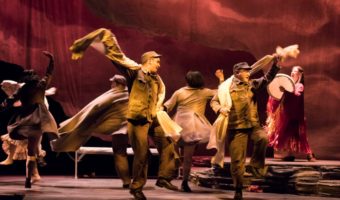
Rob Monk, Robert Sidley, Devin Pihlainen and Brian Hinson in FCP's The Tempermentals. Not Pictured: David Nicks. Photo by Devin Karringten.


The play shows us just how hostile the McCarthy era was towards homosexuals, suspected leftists, or anyone thought of as threatening to the fabric of “good, clean American society”. The danger of the times is especially strident in the crackly recordings of General McCarthy‘s outrageous speeches that intersperse the performance. I couldn’t help but laugh at his warnings about how to spot a communist, because they were delivered in dead seriousness, but sound like the ravings of one who has taken leave of his senses entirely. Of course, nothing is funny about his opinions, or the laws and policies they supported. We see their oppression and cruelty that hurt, bully and punish the people in the play, whose only crime is being who they are.

And in this dark and hostile climate, there is a beautiful, hopeful thing: the love between Harry and Rudi. It is a sweet, mischievous, witty love, between two unlikely mates. Rudi is an up-and-coming LA fashion designer, who moves easily through the glamour crowd, charming everyone in his wake. Harry on the other hand, is political science teacher, with a background in law, who is terribly passionate, but easily incensed and uncompromising in his vision of a safe society for homosexuals.


Rob Monk, Robert Sidley, Devin Pihlainen and Brian Hinson in FCP's The Tempermentals. Not Pictured: David Nicks. Photo by Devin Karringten.


Neither belongs in the other’s world — especially because Harry is married — but the two are like a refuge for each other, a space away from the world where they don’t have to fight or hide. It is really touching to see how their love for each other emboldened the movement that led to the founding of the Mattachine Society — the first specifically homophile society in the United States. Watching the play, you really get a sense of how terrifying it was to take the stand that Harry, Rudi and their allies did. But while also seeing how doing anything other than taking a stand involved living with the tremendous amount of shame and loneliness that comes from living like a fugitive while having done nothing wrong.

Harry Hay and Rudi Gernreich were stunning human beings who showed incredible courage in hard times, and their actions shaped history. I know this now thanks to The Tempermentals, playwright John Marans, Fighting Chance Productions and director Ryan Mooney for bringing this play to the Canadian stage for the first time.

The actors did an great job transporting the audience, and so did the unusual set design. It is stark and intimate with few props, and with four different platforms that light up at different times. This set up with the minimal lighting gives the impression that we are overhearing whispers, secret rendezvous, and dangerous truths. Congratulations to actors Brian Hinson (Harry Hay), Devin Pihlanien (Rudi Gernreich), James Gill, David Nicks and Rob Monk (all three of whom played a variety of characters wonderfully and in quick succession).

You can (and must) see The Tempermentals at the PAL Theatre in Vancouver until December 3rd.  Showtimes are 8 pm from  Tuesday — Saturday, 2 pm matinees on Saturday and two shows on Sunday at 2 pm & 7 pm.

.

Vancouver Theatre: The 13th Chair at Studio 58

Who doesn’t love the jazz age? The Thirteenth Chair at Studio 58 is an unusual murder mystery set in a New York speakeasy in 1929. The Studio’s production of Bayard Veiller‘s play draws heavily on theatrical and cinematic styles of the era, making the play feel like an evening’s immersion into the 1920s themselves. The 13th Chair presents a theatrical medley containing elements of dinner theatre, silent film, vaudeville, and the classic “whodunnit“. Throw in a little bit of paranormal activity, some melodrama and family intrigue, and you have a hilarious, exciting, entertaining production, brought to you by the  students of Langara’s Theatre Arts program.


Stephanie Moroz as Helen O'Neill in Studio 58's production of The Thirteenth Chair by Bayard Veiller.


I’d never been to Studio 58 before last night, and I have to say I have fallen in love with the place. Sure I had to navigate my way down a few winding staircases to get there, but for me that provided added charm — when you’re going to see a murder mystery on the rainiest of November nights, it only makes sense that the path to the theatre would have its perils. Cue thunder and all that. But fun aside, I was really impressed by how small and secluded the Studio 58 theatre is.  Draped with heavy purple fabric all around, with strict rules about exits and entrances, the audience and actors really are in a little world of their own for the duration of the play. It seems like the perfect set up for the audience to be drawn right into the story happening only a few feet away. With actors as talented as the ones in this cast, that’s exactly what happened.

Now a bit about the story — we enter it on the eve of an engagement between the son of the wealthy host and his sweetling (pictured above). Just when before their engagement is announced, a family friend (Edward Wales) objects strongly, begging the boy’s parents to wait 24 hours before they allow the engagement. His misgivings cast a shadow of suspicion upon the innocent looking Ms. O’Neill.


Lindsay Winch as Mary Eastwood in Studio 58's production of The 13th Chair by Bayard Veilles.


Much to everyone’s frustration, Wales can’t say anything about why he is suspicious, and only begs them to wait and see what the evening brings.

Later that evening a vivacious medium arrives at the party. The medium is to hold a seance that will reveal who murdered Wales’s friend, Spencer Lee — we can gather than one of the party guests is guilty. After much skepticism, laughter and magical demonstration, the group sits down to their seance. When the light’s come back on. . . can you guess? Here’s a hint: the services of one Inspector Donahue are required, and he is summoned immediately.


Kazz Leskard as Inspector Donohue in Studio 58's production of The 13th Chair by Bayard Veiller.


Don’t let the Inspector’s expression there fool you, he’s a hard-boiled detective, he is. With evidence and everything.

But don’t worry about the story ever getting too dark. When things threaten to get too serious, the two entertainers (who’s clever stage names have slipped my mind) accompanied by live piano music (composer Matt Grinke) take the stage with silly, feel-good numbers that you’ll be humming on your way home.

Thanks to director Sarah Rodgers for this wonderful play! And a warm congratulations to the whole cast and crew — there are so many talents that have contributed to this play — including an Irish Dialect Coach (Ashley O’ Connell) — that I can’t possibly name them all. Notable faces of the cast include: Cheyenne Mabberley as the medium Rosalie Le Grange, Kazz Leskard as Inspector Donahue, Stephanie Moroz as Helen O’Neill, Katey Hoffman as Grace Standish (whose character I am certain draws from Popeye’s Olive Oyl) and Joel Baillard as Edward Wales.

The costume and lighting crews are magicians, and their talent and hard work is hard to ignore in this performance.

You can see The 13th Chair at Studio 58 until December 4. Showtimes are at 8 pm from Tuesday through Saturday, with matinees at 3 pm on Saturday & Sunday.

P.S. Outside, during intermission, I found a flyer entitled “Do the Charleston like a pro!”, containing steps to the popular dance whose name I hitherto had not known. Thank you Studio 58  for educating me, about the dance and the name. While waiting for the bus in the shelter of the Canada Line station later that evening, I practiced the steps as I remembered them from the flyer. It seemed like the only thing there was to do, since it was still pouring rain and the bus was certainly taking its time.  I’m sure I provided entertainment for my fellow stranded travelers. And soon I am sure I will dance it like a pro. After all now I have inspiration.


Interview with Rumble Productions’ Craig Hall – Part 3 – Rehearsing Snowman

Last week I was fortunate enough to meet Craig Hall, Rumble Productions‘ Artistic Producer and soon to be Vertigo Theatre‘s Artistic Director. Craig is producing his last show in Vancouver before heading for Calgary, a favourite play of his called Snowman by Greg MacArthur. This is Part 3 of that interview, focused on rehearsing of Snowman.


Craig shares an inside the theatre look at Greg MacArthur's Snowman. Oct. 25, 2011


As you read the interview below, the lines in bold are my questions and the chunks of elegant prose are Craig’s answers.

What was the inspiration to get the actors of Snowman to rehearse in Stanley Park?

To be honest with you it was kind of circumstance. Besides their being a lack of theatres in this town — especially theaters that are artist run — there’s a lack of rehearsal space, a lack of places to actually create your plays. Part of the idea behind Progress Lab 1422 was we all got tired of not having a rehearsal space so we built our sets in the rehearsal hall, and rehearsed on the sets that we’re going to be performing on. It was kind of unheard of, in a weird way — it seems strange that it is kind of unheard of, for actors to be rehearsing on their sets from day 1 of rehearsal, but it is. The challenge with the Progress Lab is that there are four companies in there and occasionally, of course, there are conflicts.


A solitary path in Stanley Park. Photo by Stephen Downes.


That must be a challenge for actors to have to rehearse in a completely new space just days before their opening.

Yeah, it is. And it’s always been a challenge. That was the reason for this rehearsal space, but when there are conflicts, one company of the two has to go somewhere else, and that ended up being us just through the luck of the draw this time. The nice thing is we have a scenario where the venue actually pays for us to go rent somewhere else. In terms of rehearsing in Stanley Park we just needed a place that was of exclusive use where there’s not going to be a yoga class in there after we leave, where there’s not a bunch of Ukrainian women coming into to make perogies halfway through our rehearsal. I like the idea of being able to go out once in a while too, because a lot of Snowman takes place in the outdoors, either in a forest or on a glacier. A lot of it is quite intimate in its nature so it’s kind of got a feeling of two people walking on a path and telling each other a story. We’ve been using it as an opportunity to get out of the room once in a while, wander through the trees to practice our lines and get a sense of what it means to actually look someone in the eye and tell them a story.

Do you think these outdoor rehearsals will influence the way the play is performed?

Oh, absolutely. The first day of rehearsal, we actually left the room. I said “Okay everybody, get your stuff on,” and we went out. And I asked them each to tell a personal story, something that they felt strongly about and a story that they were good at telling, that they really wanted to tell. We did that, we just wandered through the trees and told stories. What I was trying to do was highlight to them that even though they’re telling a story that happened in the past, that all of that emotion, and all of the poignancy of the moments inside these stories are still there and come rushing back when you’re telling them. Because Snowman often has the tone of hindsight, it would be easy to say “Oh it all happened before, so there is no emotion to the story, so I could just tell it.” Well, when I asked these guys to tell their personal stories, especially the two men in the cast, both of them burst into tears, one of them was talking about this life-threatening situation he had with his heart, and the other one was talking about the birth of his son. . . All the emotions were just so on the surface. It was a nice way of showing them that even though this story is told in hindsight it has to be in the moment and real in its telling. It doesn’t matter how much distance there is if it’s an important personal experience, it will have resonance.


Photo by Jarek Zdziech


How do you interpret the creative vision behind Snowman? What do you think is driving that play?

It’s a play that’s about isolation, in a way. These four people are in this very isolated place in northern Alberta or the Yukon– that’s where we think of it as — they come to what you could see as the edge of the world, because they are living at the edge of a glacial shield. They’re all living there together, and theoretically they all love and know each other, and yet they’ve stopped communicating years and years ago. So everything that they’re saying on stage, they’re telling the audience what they were feeling, but they’re not telling each other, and they’re very isolated. . . and kind of frozen. They’ve been going on the same track for so long, they’re not really sure why they’re going down that road any more, and they’ve literally just being traveling north. Because they didn’t have anywhere else to go or anything else to do, and as they’ve done that they’ve forgotten why they’re doing what they’re doing, they’ve stopped communicating with each other as couples sometimes do, and they’re stuck in a rut — they’re frozen in time, in a way, just going through their routine without any heat or passion in what their doing. . .

Greg‘s funny because he’s from Montreal and is very much a city kinda guy, a transient guy that goes wherever the work is and so on. But all his plays for some reason are set in the North, and he’s not from there. But I think there’s something in the North the speaks to him in terms of alienation and isolation.


Photo by Jos van Wunnik


What does your creative process involve? Is it like talking to yourself, walking around the city?

It’s exactly that! You make doodles, you talk to yourself, there’s a Shakespearean thing where he talks about “Your eyes in fine frenzy rolling” which is basically that creative moment where your eyes are rolling in the back of your head and you’re just imagining it. I’m a big walker, I think best when I’m just walking around, and you just kind of start picturing it. That’s how I do it anyways, I just start to imagine the world, the rules of the world and then I start to bring other people in to what I’m envisioning and we build from there and it becomes a much more collaborative process. And sometimes I search images online, like for this play I found a picture of this white birch forest. There was something about the stark, monolithic nature of these trees that spoke to me with this play. You just start building a world in your mind. Sometimes it’s an easy thing and sometimes it’s not.

Craig Hall’s last production in Vancouver for the time-being, Greg MacArthur’s Snowman, opens tonight and runs from November 4th – 19th, 2011 at the Art’s Club Revue Stage on Granville Island.

Interview with Rumble Productions’ Craig Hall – Part 2 – Hive & the 4th Wall

Last week I was fortunate enough to meet Craig Hall, Rumble Productions‘ Artistic Producer and soon to be Vertigo Theatre‘s Artistic Director. Craig is producing his last show in Vancouver before heading for Calgary, a favourite play of his called Snowman by Greg MacArthur. This is Part 2 of that interview, focused on discussing the theatrical phenomena of Hive and the Fourth Wall of the Theatre.


I wasn't the only one interested in talking to Craig Hall. This blackbird flew by for a chat too. Oct 25 2011.


Hive for those of you not familiar with it was a collaboration between 12 theatre companies with 12 distinct performance and a whole lot of social thrown in. Think party, theatre-style. The Fourth Wall in the Theatre is the imaginary wall at the front of the stage.  In Hive this wall is removed by the audience becoming more of a participant within the performance.

As you read the interview below, the lines in bold are my questions and the chunks of elegant prose are Craig’s answers.

I notice that after your becoming Artistic Producer of Rumble, the theatrical phenomenon of Hive began. What was the inspiration behind this project?

Hive was an event, but the predecessor of the event was a thing called Progress Lab, which was the brainchild of Kim Collier, the woman who runs The Electric Company. Kim had this idea that there was no conversation happening, that we were all stuck in our little companies, doing our thing and toiling away. She got tired of not being able to have a conversation about the problems she was having or sharing her successes and so on, so she started Progress Lab. It was a very informal thing: it was just an opportunity of every once in a while, getting together and quite honestly, drinking a bit and eating a bit and in a semi-structured kind of way we’d talk about what everybody was doing.

Well, you do that and inevitably, it leads to some ideas. So Hive was an idea that bubbled to the surface one night out of this collection of (at that time) eleven companies’ artistic directors, artistic personnel and even administrators and managers. Everyone was so inspired and inspiring. I could not tell you the gist of where the seed of the idea came from, I don’t think any of us could tell you that. And like Progress Lab it was an opportunity for us all to do something together. To give ourselves the opportunity to just do something outrageous or completely wrong, with no pressure of extended runs and everything else. We just had the chance to make these beautiful little tidbits where we could do something outrageous and see what happens. And one thing we didn’t realize was that each of these companies had a limited reach for their audiences . . . well, you put eleven companies together and that reach is massive.


Kunaka Marimba band plays at Hive 2. Image from buzzbuzzbuzz.ca.


We didn’t even advertise the event and it just sold out, because the buzz was out there. . . “What are they doing? Why are they doing this? Where are they doing this?” The buzz swept across the country, in the theatre communities at least. The second Hive we did at Magnetic North. They caught wind of it and asked us if we could do that again. For them it was a way for them to come to town and actually profile the work of eleven companies when they generally would only do two or three. That was another big success that sold out. Then with the Cultural Olympiad, they came back and asked us to do it a third time.

It seems that Hive dissolved the fourth wall a little bit, because it made the process of going to the theatre more participatory, drop-in and mingly.  Was the goal of Hive to make theatre that was more like that?

Yeah, I say I don’t know where the seed for Hive came from, but in a way it sort of came from the desire to have a big party, and to have theatre be a part of that party.  Like you went in and you got a menu of what you’d get to see and as an audience member you had to actively work to make sure you could see the one that you wanted to see, and had to figure out how to get in. So it was very participatory, and some of the little shows were more participatory than others, but generally the feel of the whole event was very participatory and social … hugely social in fact, in a way that theatre generally isn’t. You’re usually stuck into this cold room, they turn the lights out and you sit there by yourself, anonymously. And in this event, there was no being anonymous. Partly because of the intimate nature of the work and partly because you had to interact with other audience members to figure out how they got to see this or that show.


Linda Quibell of Felix Culpa performs at Hive. Photo from buzzbuzzbuzz.ca.


What do you think the audience was receiving from Hive that made it so attractive to them and popular? Do you think there was some intimacy in the theatre offered with Hive?

I think there’s that, and because of the nature of the theatre in Vancouver — Vancouver’s always had really site-specific theatre where you have to go to this strange place [to see a show]– we don’t have a lot of venues. I think that because of that the audiences here are used to participating a little bit and being thrown a bit of a curveball. I think the possibilities that Hive offered of a) being able to have a drink b) the fact that each of these shows is about ten minutes long c) if they didn’t like it, they could go find the next one. They got this sort of taster menu, and people love taster menus at restaurants, because they get to try a little bit of everything. And I think in some ways these people could come to this event and try out the work of twelve different theatre companies, and then from there decide which companies they liked. Our hope always was that they would follow up with the companies that they did like and go to their other shows. I think the social aspect of it was what people really got off on.

In an earlier interview, you express how you’re not a fan of the view of  ’theatre as medicine’, or something that’s done as a chore. I’ve read that one of the purposes of theatre is to disturb the comforted and comfort the disturbed. Do you think this is what theatre should be? What do you think theatre does?

I think there’s all sorts of kind of theatre. I mean there’s pure entertainment — I’m about to take over a company in Calgary that really sees itself as a popular theatre. In the same way that murder mystery, as a genre of fiction, is seen as the junk food of fiction, well that’s what murder mystery is in theatre as well, people like to come and have fun and be entertained and then to leave, to not have to challenge their political views necessarily — maybe subversively sometimes, but it’s primarily about the entertainment of it. There’s agitprop theatre, or theatre with a political bent and some people really like that — they like something that challenges the way they look at the world. I think theatre-makers make theatre for different reasons, sometimes to challenge the staus quo, sometimes just because it’s like they have this really funny joke that they want to tell for an hour. With Canadian English Theatre, there is no real history or culture of it in our society. People get introduced to it, but there are very few people that grow up with it as part of their regular lives, so I think very often people are dragged there by someone who does go to more theatre — very often by their girlfriend or their wife, to be honest — and they’re forced to sit there and take this thing in, and it’s generally kind of boring and they don’t necessarily understand the language and it’s not really that relevant to their lives — at least I think that’s the preconception that they go in with. But I think theatre in this town is rarely that anymore, and if it is it’s Bard on the Beach or the Playhouse. But other than that I think theatre now is a much more rigorous, fun and engaged activity in the way that music is or fashion is — but I don’t think we’ve managed to convince people of that just yet.

Craig Hall’s last production in Vancouver for the time-being, Greg MacArthur’s Snowman, opens this week and runs from November 4th – 19th, 2011 at the Arts Club Revue Stage on Granville Island.

Stay tuned tomorrow for Part 3 of the Craig Hall Interview and a look into the rehearsing of Snowman.

Interview with Rumble Productions’ Craig Hall – Part 1 – The Artistic Producer

I was fortunate enough to meet Craig Hall, Rumble Productions‘ Artistic Producer and soon to be Vertigo Theatre‘s Artistic Director, this past week.  Craig is producing his last show in Vancouver before heading for Calgary, a favourite play of his called Snowman by Greg MacArthur. We had our interview on his lunch break from rehearsals, during which I learned a lot about theatre, the creative process and Snowman. I am honoured to have shared the following exchange with him — the lines in bold are my questions and the chunks of elegant prose are his answers. This is the first post in a 3-part Series on my conversation with Craig Hall.


Craig Hall, Creative Producer for Rumble Productions. Oct 25 2011


What is it about a play that makes you want to produce it?

I think that’s a really hard thing to put a finger on.  Sometimes a play is good for a company, because it just fits perfectly with their mandate, or it’ll be a really great audience draw, but sometimes a play is just really right for you as an artist … I think you just know. You start right away with your own tastes — I don’t think I’d ever program anything that I really hate. But having said that my tastes are pretty wide, I don’t like just one particular kind of work. That’s why at Rumble over the years I’ve kept the ideas very broad, because I don’t want to do just physical-based theatre or just one type of theatre — I like all sorts of theatre.

What are some of your favourite plays?

Well actually Snowman is one of my favourite Canadian plays that I’ve come across over the last ten years, which is why I’m coming back to it again after all this time. My tastes tend to be slightly dark, tending towards the dark comedies. There was a show they just did at the Shaw Festival called When the Rain Stops Falling by the Australian writer Andrew Bovell. It was kind’ve dark and I actually really like filmic stuff like that on stage.

On that note, I’ve heard some in theatre sound slightly bitter about ours being a ‘going-to-the-movies’ culture. What are your thoughts about that attitude?

I think people say that for different reasons. I think there is a reaction to theatre that is perceived as ‘sitcoms on stage’ or movie melodrama on stage, where it’s like you could put the play up on a screen and it would be the same. But I like the challenge of having things on stage which have a really broad scope, and like a hundred locations, and where you can be really conceptual with how you approach them.


Photo by Bridget AMES.


In a show like When the Rain Stops Falling or a couple of shows of this Scottish writer David Greig, one called San Diego and another called (it’s a long one) A Cosmonaut’s Last Message to a Woman He Once Loved in the Former Soviet Union, they go through time and space. One minute you’ll be in the now and then you’ll be in fifteen years from now. I love the challenge of having to take an audience on that journey in one small black box or stage, just through simple stage magic and ideas — being able to transport people that way is really exciting. I’m drawn much more to that sort of play than to a play that takes place in the drawing room of an old English country house and stays there. I think [in the former] you have much more free range of storytelling and a much fuller range in the theatricality of it.

Are there some films or filmic plays that you like?

I think the plays I just mentioned and Snowman are very filmic plays and in a different way. Greg’s writing style is very direct address, the actors on stage talk directly to the audience. There’s sort of a hindsight quality to them, almost like a documentarian has come across these people after the events and started asking them what happened. They basically start to tell the story of what happened. Very often they’re talking directly to you and then suddenly they’re in the past, actively entrenched in the story, but then they’ll pop right back out again. The layers and layers of registers is what’s really challenging about the piece.


We were visited by a chatty black bird part way through the interview. Oct 25 2011.


It’s funny, when I first did Snowman back in 2003, there was no context for this style, this direct address style was very new. It was not to everybody’s taste, because a lot of people liked to have that veil, that fourth wall comes down and you just sit back and watch things unfold. They didn’t like to be talked to, but I loved it. But now, doing this play in 2011, we have TV shows like The Office and Modern Family where there’s this strange mockumentary thing, where characters are doing exactly that and talking to the camera. So in some ways it kind of makes our job a little more challenging, because people understand that convention now, and and in some ways it makes them complacent with it. But it also helps because the audience knows what this is now, and they are able to sit back and be okay with it.

What motivates you to do the work that you do? What does it do for you personally and what do you think that it’s doing in the world?

That’s a good question. I’ve always struggled with that question, because there are other artists out there that have a real agenda in what they’re doing. They’re out to change the way people think or change the world or at the very least to shed light on something. I’ve never been motivated that way, I just really like stories. I read a lot of stories, I write stories occasionally, I love movies, I love to be entertained. It’s not that I don’t think there are poignant things to be said, but often that stuff is secondary to just wanting to either hear or tell really great story.

Craig Hall’s last production for the time-being in Vancouver, Greg MacArthur’s Snowman, opens this week and runs from November 4th – 19th, 2011 at the Arts Club Revue Stage on Granville Island.