A Great End to a Great Week!

Jesse Roper playing at the IBC Canadian Showcase

As far as week’s go, this past week has been pretty damn fantastic ~ enjoying my first music pilgrimage into the history of Rock & Roll and the Blues in Memphis, discovering some bloody fantastic Blues talent at the International Blues Challenge, cheering Canadian Ross Neilsen on in the Semi-Finals of the International Blues Challenge, and coming home to discover some simply beautiful music that Chris Blake has written for Roamancing.  Now to top it all off, I went to pull the name of a winner for Studio 58‘s Julius Caesar tickets and was thrilled to pull Kelly Lui’s name, who interned with Ahimsa Media this past summer.  To make this especially fantastic, I went to congratulate Kelly and discovered it was her birthday!  Happy Birthday Kelly!

For those that entered, but didn’t win, we are entering you for a second chance at the tickets on Roamancing’s site.  For anyone unaware of the contest, that wishes they’d entered, you can still do that on Roamancing’s site until midnight.  Just drop us a comment with which Shakespeare play you would most love to see as a gender bender (ie. with men and women playing opposite gender role). Here’s a little of what you can expect from the play:


Catch this gender bender of a Julius Caesar at Studio 58 in Vancouver, February 2nd – 26th, Tuesdays – Saturdays at 8 pm and Saturdays & Sundays at 3 pm. Tickets can be purchased here.

Interview with Rumble Productions’ Craig Hall – Part 3 – Rehearsing Snowman

Last week I was fortunate enough to meet Craig Hall, Rumble Productions‘ Artistic Producer and soon to be Vertigo Theatre‘s Artistic Director. Craig is producing his last show in Vancouver before heading for Calgary, a favourite play of his called Snowman by Greg MacArthur. This is Part 3 of that interview, focused on rehearsing of Snowman.


Craig shares an inside the theatre look at Greg MacArthur's Snowman. Oct. 25, 2011


As you read the interview below, the lines in bold are my questions and the chunks of elegant prose are Craig’s answers.

What was the inspiration to get the actors of Snowman to rehearse in Stanley Park?

To be honest with you it was kind of circumstance. Besides their being a lack of theatres in this town — especially theaters that are artist run — there’s a lack of rehearsal space, a lack of places to actually create your plays. Part of the idea behind Progress Lab 1422 was we all got tired of not having a rehearsal space so we built our sets in the rehearsal hall, and rehearsed on the sets that we’re going to be performing on. It was kind of unheard of, in a weird way — it seems strange that it is kind of unheard of, for actors to be rehearsing on their sets from day 1 of rehearsal, but it is. The challenge with the Progress Lab is that there are four companies in there and occasionally, of course, there are conflicts.


A solitary path in Stanley Park. Photo by Stephen Downes.


That must be a challenge for actors to have to rehearse in a completely new space just days before their opening.

Yeah, it is. And it’s always been a challenge. That was the reason for this rehearsal space, but when there are conflicts, one company of the two has to go somewhere else, and that ended up being us just through the luck of the draw this time. The nice thing is we have a scenario where the venue actually pays for us to go rent somewhere else. In terms of rehearsing in Stanley Park we just needed a place that was of exclusive use where there’s not going to be a yoga class in there after we leave, where there’s not a bunch of Ukrainian women coming into to make perogies halfway through our rehearsal. I like the idea of being able to go out once in a while too, because a lot of Snowman takes place in the outdoors, either in a forest or on a glacier. A lot of it is quite intimate in its nature so it’s kind of got a feeling of two people walking on a path and telling each other a story. We’ve been using it as an opportunity to get out of the room once in a while, wander through the trees to practice our lines and get a sense of what it means to actually look someone in the eye and tell them a story.

Do you think these outdoor rehearsals will influence the way the play is performed?

Oh, absolutely. The first day of rehearsal, we actually left the room. I said “Okay everybody, get your stuff on,” and we went out. And I asked them each to tell a personal story, something that they felt strongly about and a story that they were good at telling, that they really wanted to tell. We did that, we just wandered through the trees and told stories. What I was trying to do was highlight to them that even though they’re telling a story that happened in the past, that all of that emotion, and all of the poignancy of the moments inside these stories are still there and come rushing back when you’re telling them. Because Snowman often has the tone of hindsight, it would be easy to say “Oh it all happened before, so there is no emotion to the story, so I could just tell it.” Well, when I asked these guys to tell their personal stories, especially the two men in the cast, both of them burst into tears, one of them was talking about this life-threatening situation he had with his heart, and the other one was talking about the birth of his son. . . All the emotions were just so on the surface. It was a nice way of showing them that even though this story is told in hindsight it has to be in the moment and real in its telling. It doesn’t matter how much distance there is if it’s an important personal experience, it will have resonance.


Photo by Jarek Zdziech


How do you interpret the creative vision behind Snowman? What do you think is driving that play?

It’s a play that’s about isolation, in a way. These four people are in this very isolated place in northern Alberta or the Yukon– that’s where we think of it as — they come to what you could see as the edge of the world, because they are living at the edge of a glacial shield. They’re all living there together, and theoretically they all love and know each other, and yet they’ve stopped communicating years and years ago. So everything that they’re saying on stage, they’re telling the audience what they were feeling, but they’re not telling each other, and they’re very isolated. . . and kind of frozen. They’ve been going on the same track for so long, they’re not really sure why they’re going down that road any more, and they’ve literally just being traveling north. Because they didn’t have anywhere else to go or anything else to do, and as they’ve done that they’ve forgotten why they’re doing what they’re doing, they’ve stopped communicating with each other as couples sometimes do, and they’re stuck in a rut — they’re frozen in time, in a way, just going through their routine without any heat or passion in what their doing. . .

Greg‘s funny because he’s from Montreal and is very much a city kinda guy, a transient guy that goes wherever the work is and so on. But all his plays for some reason are set in the North, and he’s not from there. But I think there’s something in the North the speaks to him in terms of alienation and isolation.


Photo by Jos van Wunnik


What does your creative process involve? Is it like talking to yourself, walking around the city?

It’s exactly that! You make doodles, you talk to yourself, there’s a Shakespearean thing where he talks about “Your eyes in fine frenzy rolling” which is basically that creative moment where your eyes are rolling in the back of your head and you’re just imagining it. I’m a big walker, I think best when I’m just walking around, and you just kind of start picturing it. That’s how I do it anyways, I just start to imagine the world, the rules of the world and then I start to bring other people in to what I’m envisioning and we build from there and it becomes a much more collaborative process. And sometimes I search images online, like for this play I found a picture of this white birch forest. There was something about the stark, monolithic nature of these trees that spoke to me with this play. You just start building a world in your mind. Sometimes it’s an easy thing and sometimes it’s not.

Craig Hall’s last production in Vancouver for the time-being, Greg MacArthur’s Snowman, opens tonight and runs from November 4th – 19th, 2011 at the Art’s Club Revue Stage on Granville Island.

Interview with Rumble Productions’ Craig Hall – Part 2 – Hive & the 4th Wall

Last week I was fortunate enough to meet Craig Hall, Rumble Productions‘ Artistic Producer and soon to be Vertigo Theatre‘s Artistic Director. Craig is producing his last show in Vancouver before heading for Calgary, a favourite play of his called Snowman by Greg MacArthur. This is Part 2 of that interview, focused on discussing the theatrical phenomena of Hive and the Fourth Wall of the Theatre.


I wasn't the only one interested in talking to Craig Hall. This blackbird flew by for a chat too. Oct 25 2011.


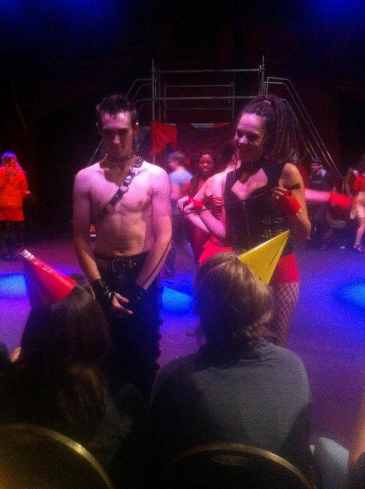
Hive for those of you not familiar with it was a collaboration between 12 theatre companies with 12 distinct performance and a whole lot of social thrown in. Think party, theatre-style. The Fourth Wall in the Theatre is the imaginary wall at the front of the stage.  In Hive this wall is removed by the audience becoming more of a participant within the performance.

As you read the interview below, the lines in bold are my questions and the chunks of elegant prose are Craig’s answers.

I notice that after your becoming Artistic Producer of Rumble, the theatrical phenomenon of Hive began. What was the inspiration behind this project?

Hive was an event, but the predecessor of the event was a thing called Progress Lab, which was the brainchild of Kim Collier, the woman who runs The Electric Company. Kim had this idea that there was no conversation happening, that we were all stuck in our little companies, doing our thing and toiling away. She got tired of not being able to have a conversation about the problems she was having or sharing her successes and so on, so she started Progress Lab. It was a very informal thing: it was just an opportunity of every once in a while, getting together and quite honestly, drinking a bit and eating a bit and in a semi-structured kind of way we’d talk about what everybody was doing.

Well, you do that and inevitably, it leads to some ideas. So Hive was an idea that bubbled to the surface one night out of this collection of (at that time) eleven companies’ artistic directors, artistic personnel and even administrators and managers. Everyone was so inspired and inspiring. I could not tell you the gist of where the seed of the idea came from, I don’t think any of us could tell you that. And like Progress Lab it was an opportunity for us all to do something together. To give ourselves the opportunity to just do something outrageous or completely wrong, with no pressure of extended runs and everything else. We just had the chance to make these beautiful little tidbits where we could do something outrageous and see what happens. And one thing we didn’t realize was that each of these companies had a limited reach for their audiences . . . well, you put eleven companies together and that reach is massive.


Kunaka Marimba band plays at Hive 2. Image from buzzbuzzbuzz.ca.


We didn’t even advertise the event and it just sold out, because the buzz was out there. . . “What are they doing? Why are they doing this? Where are they doing this?” The buzz swept across the country, in the theatre communities at least. The second Hive we did at Magnetic North. They caught wind of it and asked us if we could do that again. For them it was a way for them to come to town and actually profile the work of eleven companies when they generally would only do two or three. That was another big success that sold out. Then with the Cultural Olympiad, they came back and asked us to do it a third time.

It seems that Hive dissolved the fourth wall a little bit, because it made the process of going to the theatre more participatory, drop-in and mingly.  Was the goal of Hive to make theatre that was more like that?

Yeah, I say I don’t know where the seed for Hive came from, but in a way it sort of came from the desire to have a big party, and to have theatre be a part of that party.  Like you went in and you got a menu of what you’d get to see and as an audience member you had to actively work to make sure you could see the one that you wanted to see, and had to figure out how to get in. So it was very participatory, and some of the little shows were more participatory than others, but generally the feel of the whole event was very participatory and social … hugely social in fact, in a way that theatre generally isn’t. You’re usually stuck into this cold room, they turn the lights out and you sit there by yourself, anonymously. And in this event, there was no being anonymous. Partly because of the intimate nature of the work and partly because you had to interact with other audience members to figure out how they got to see this or that show.


Linda Quibell of Felix Culpa performs at Hive. Photo from buzzbuzzbuzz.ca.


What do you think the audience was receiving from Hive that made it so attractive to them and popular? Do you think there was some intimacy in the theatre offered with Hive?

I think there’s that, and because of the nature of the theatre in Vancouver — Vancouver’s always had really site-specific theatre where you have to go to this strange place [to see a show]– we don’t have a lot of venues. I think that because of that the audiences here are used to participating a little bit and being thrown a bit of a curveball. I think the possibilities that Hive offered of a) being able to have a drink b) the fact that each of these shows is about ten minutes long c) if they didn’t like it, they could go find the next one. They got this sort of taster menu, and people love taster menus at restaurants, because they get to try a little bit of everything. And I think in some ways these people could come to this event and try out the work of twelve different theatre companies, and then from there decide which companies they liked. Our hope always was that they would follow up with the companies that they did like and go to their other shows. I think the social aspect of it was what people really got off on.

In an earlier interview, you express how you’re not a fan of the view of  ’theatre as medicine’, or something that’s done as a chore. I’ve read that one of the purposes of theatre is to disturb the comforted and comfort the disturbed. Do you think this is what theatre should be? What do you think theatre does?

I think there’s all sorts of kind of theatre. I mean there’s pure entertainment — I’m about to take over a company in Calgary that really sees itself as a popular theatre. In the same way that murder mystery, as a genre of fiction, is seen as the junk food of fiction, well that’s what murder mystery is in theatre as well, people like to come and have fun and be entertained and then to leave, to not have to challenge their political views necessarily — maybe subversively sometimes, but it’s primarily about the entertainment of it. There’s agitprop theatre, or theatre with a political bent and some people really like that — they like something that challenges the way they look at the world. I think theatre-makers make theatre for different reasons, sometimes to challenge the staus quo, sometimes just because it’s like they have this really funny joke that they want to tell for an hour. With Canadian English Theatre, there is no real history or culture of it in our society. People get introduced to it, but there are very few people that grow up with it as part of their regular lives, so I think very often people are dragged there by someone who does go to more theatre — very often by their girlfriend or their wife, to be honest — and they’re forced to sit there and take this thing in, and it’s generally kind of boring and they don’t necessarily understand the language and it’s not really that relevant to their lives — at least I think that’s the preconception that they go in with. But I think theatre in this town is rarely that anymore, and if it is it’s Bard on the Beach or the Playhouse. But other than that I think theatre now is a much more rigorous, fun and engaged activity in the way that music is or fashion is — but I don’t think we’ve managed to convince people of that just yet.

Craig Hall’s last production in Vancouver for the time-being, Greg MacArthur’s Snowman, opens this week and runs from November 4th – 19th, 2011 at the Arts Club Revue Stage on Granville Island.

Stay tuned tomorrow for Part 3 of the Craig Hall Interview and a look into the rehearsing of Snowman.

Out & About Covering the Arts Across North America

You may have noticed that despite this site bearing my name, our list of writers writing here is growing, this is partially as I have so many talented friends, like Brie and Rob Jones, who enjoy writing here; partly due to Ahimsa Media’s goal of fostering young storytellers, like Alyzee, Summer and Kelly; and as we are getting set to launch Roamancing, which will involve a number of storytellers, but has been temporarily delayed by the ups & downs that life throws at you.

With this, we have found our writers have spread out across North America for the summer, which means opportunities for us to cover the Arts beyond Vancouver.  While our core team will still be in and around Vancouver this summer, I (Emme) will be based in Southern Ontario, Hamilton to be specific, and Brie will be in LA.


Stacey Robinsmith and I at the Canadian Premiere of Nixon in China at the Vancouver Opera.


So if you have an arts event (theatre, music, fashion, food & beverage …) that you’d like one of our writers to attend and weave a tale around, fire me a note at emme@emmerogers.com and I will see if someone is eager and available.

As for me, you know I absolutely adore theatre, music, the opera … and would love to check out this scene in Ontario, along with looking forward to checking out the Gimli Film Festival for the first time in Manitoba in a little over a week’s time.

Brie loves theatre and music too, but she also adores dance and fashion, and with Young Master Mason and Little Miss Mason in the wings, I know would enjoy taking in some events that are suited to families with 9 – 12 year olds too.

Vancouver – you are already, of course, familiar with the types of storytelling that our Vancouver Cats, like Rob Jones and Alyzee Lakhani, are capable of for music and theatre.


Hanging with Ron Sexsmith & Rob Jones - two of my music legends.

Looking forwarding to sampling a few new flavours this summer.

Kisses,

Emme   xoxo

Haunted at the Metro Theatre: A Van Sexy Date Pick

I am not at all sure what this says about me, but I have discovered this past year, thanks to Fighting Chance ProductionsSweeney Todd and The Lieutenant of Inishmore and most recently the Metro Theatre‘s Haunted, that I have a real affinity to dark, sinister and morbid comedies.  And to make things even worse, these are amoung my top Van Sexy Date Picks for the past year. So that I don’t spend too much time over analyzing what this says about me, let us just assume that this is my infinite wisdom in testing out a man – a) he has to have a sense of humour, b) he should want to protect me, and c) I should want to cuddle up next to him whether I’m scared or not.

So this brings me back to my latest Van Sexy Date Pick: Haunted by Eric Chappell, that opened at the Metro Theatre last night.  Thoroughly enjoyed this!  Director Catherine Morrison made some exceptionally strong choices in her rendition of Haunted from some strong casting, to a superb set (that I wouldn’t mind moving into), to some wickedly good choices of music, movement and lighting to set the tone and the mood.  They had me and my date captivated from the get go.

Now I don’t want to go to much into the plot, but there were certainly elements of it that I could relate to, as it is about a writer, who having had a bad review is suffering from writer’s block and a potential nervous breakdown.  What unfolds from there, may be all a figment of a wildly active imagination or may be one of those things in life that we just can’t explain.  Either way, our writer is met with a bit of inspiration, in the form of an artifact from his idol, Lord Byron.  Now I don’t know how much you know of Lord Byron, but he was rumoured to be a bit of a Ladies’ Man, so amoungst other revelations our writer had, things definitely got a little more titillating.  I should warn you though, despite the ideas that this may put in yours and your date’s heads, Lord Byron also believed that men and women shouldn’t live together. Obviously a fatal flaw in his character.

Lisa Gach and Samuel B Barnes, as photographed by Brian Campbell, in Haunted.

Now I’d be remiss by not mentioning the great cast here – Samuel B Barnes as Nigel Burke (the writer), Emma Drury as Mary Burke, Kevin Sloan as Potter, Lisa Gach as Julia Phillips, Eric Freilich as Lord Byron and Robert Sterling as Turner Gould.  Samuel was an especially wonderful surprise as I saw him not too long ago in Here on the Flight Path when he played a very different character.  He played these two characters so different, that to me as a patron of the theatre, he was totally unrecognizable.  Bravo!

You can catch Eric Chappell’s Haunted at the Metro Theatre until June 4th. Performances are on Thursday to Saturday nights at 8 pm, with two Sunday matinées at 2 pm on May 15th and 29th.

Kisses,

Emme xoxo