Interview with Rumble Productions’ Craig Hall – Part 2 – Hive & the 4th Wall
Last week I was fortunate enough to meet Craig Hall, Rumble Productions‘ Artistic Producer and soon to be Vertigo Theatre‘s Artistic Director. Craig is producing his last show in Vancouver before heading for Calgary, a favourite play of his called Snowman by Greg MacArthur. This is Part 2 of that interview, focused on discussing the theatrical phenomena of Hive and the Fourth Wall of the Theatre.


I wasn't the only one interested in talking to Craig Hall. This blackbird flew by for a chat too. Oct 25 2011.


Hive for those of you not familiar with it was a collaboration between 12 theatre companies with 12 distinct performance and a whole lot of social thrown in. Think party, theatre-style. The Fourth Wall in the Theatre is the imaginary wall at the front of the stage.  In Hive this wall is removed by the audience becoming more of a participant within the performance.

As you read the interview below, the lines in bold are my questions and the chunks of elegant prose are Craig’s answers.

I notice that after your becoming Artistic Producer of Rumble, the theatrical phenomenon of Hive began. What was the inspiration behind this project?

Hive was an event, but the predecessor of the event was a thing called Progress Lab, which was the brainchild of Kim Collier, the woman who runs The Electric Company. Kim had this idea that there was no conversation happening, that we were all stuck in our little companies, doing our thing and toiling away. She got tired of not being able to have a conversation about the problems she was having or sharing her successes and so on, so she started Progress Lab. It was a very informal thing: it was just an opportunity of every once in a while, getting together and quite honestly, drinking a bit and eating a bit and in a semi-structured kind of way we’d talk about what everybody was doing.

Well, you do that and inevitably, it leads to some ideas. So Hive was an idea that bubbled to the surface one night out of this collection of (at that time) eleven companies’ artistic directors, artistic personnel and even administrators and managers. Everyone was so inspired and inspiring. I could not tell you the gist of where the seed of the idea came from, I don’t think any of us could tell you that. And like Progress Lab it was an opportunity for us all to do something together. To give ourselves the opportunity to just do something outrageous or completely wrong, with no pressure of extended runs and everything else. We just had the chance to make these beautiful little tidbits where we could do something outrageous and see what happens. And one thing we didn’t realize was that each of these companies had a limited reach for their audiences . . . well, you put eleven companies together and that reach is massive.


Kunaka Marimba band plays at Hive 2. Image from buzzbuzzbuzz.ca.


We didn’t even advertise the event and it just sold out, because the buzz was out there. . . “What are they doing? Why are they doing this? Where are they doing this?” The buzz swept across the country, in the theatre communities at least. The second Hive we did at Magnetic North. They caught wind of it and asked us if we could do that again. For them it was a way for them to come to town and actually profile the work of eleven companies when they generally would only do two or three. That was another big success that sold out. Then with the Cultural Olympiad, they came back and asked us to do it a third time.

It seems that Hive dissolved the fourth wall a little bit, because it made the process of going to the theatre more participatory, drop-in and mingly.  Was the goal of Hive to make theatre that was more like that?

Yeah, I say I don’t know where the seed for Hive came from, but in a way it sort of came from the desire to have a big party, and to have theatre be a part of that party.  Like you went in and you got a menu of what you’d get to see and as an audience member you had to actively work to make sure you could see the one that you wanted to see, and had to figure out how to get in. So it was very participatory, and some of the little shows were more participatory than others, but generally the feel of the whole event was very participatory and social … hugely social in fact, in a way that theatre generally isn’t. You’re usually stuck into this cold room, they turn the lights out and you sit there by yourself, anonymously. And in this event, there was no being anonymous. Partly because of the intimate nature of the work and partly because you had to interact with other audience members to figure out how they got to see this or that show.


Linda Quibell of Felix Culpa performs at Hive. Photo from buzzbuzzbuzz.ca.


What do you think the audience was receiving from Hive that made it so attractive to them and popular? Do you think there was some intimacy in the theatre offered with Hive?

I think there’s that, and because of the nature of the theatre in Vancouver — Vancouver’s always had really site-specific theatre where you have to go to this strange place [to see a show]– we don’t have a lot of venues. I think that because of that the audiences here are used to participating a little bit and being thrown a bit of a curveball. I think the possibilities that Hive offered of a) being able to have a drink b) the fact that each of these shows is about ten minutes long c) if they didn’t like it, they could go find the next one. They got this sort of taster menu, and people love taster menus at restaurants, because they get to try a little bit of everything. And I think in some ways these people could come to this event and try out the work of twelve different theatre companies, and then from there decide which companies they liked. Our hope always was that they would follow up with the companies that they did like and go to their other shows. I think the social aspect of it was what people really got off on.

In an earlier interview, you express how you’re not a fan of the view of  ’theatre as medicine’, or something that’s done as a chore. I’ve read that one of the purposes of theatre is to disturb the comforted and comfort the disturbed. Do you think this is what theatre should be? What do you think theatre does?

I think there’s all sorts of kind of theatre. I mean there’s pure entertainment — I’m about to take over a company in Calgary that really sees itself as a popular theatre. In the same way that murder mystery, as a genre of fiction, is seen as the junk food of fiction, well that’s what murder mystery is in theatre as well, people like to come and have fun and be entertained and then to leave, to not have to challenge their political views necessarily — maybe subversively sometimes, but it’s primarily about the entertainment of it. There’s agitprop theatre, or theatre with a political bent and some people really like that — they like something that challenges the way they look at the world. I think theatre-makers make theatre for different reasons, sometimes to challenge the staus quo, sometimes just because it’s like they have this really funny joke that they want to tell for an hour. With Canadian English Theatre, there is no real history or culture of it in our society. People get introduced to it, but there are very few people that grow up with it as part of their regular lives, so I think very often people are dragged there by someone who does go to more theatre — very often by their girlfriend or their wife, to be honest — and they’re forced to sit there and take this thing in, and it’s generally kind of boring and they don’t necessarily understand the language and it’s not really that relevant to their lives — at least I think that’s the preconception that they go in with. But I think theatre in this town is rarely that anymore, and if it is it’s Bard on the Beach or the Playhouse. But other than that I think theatre now is a much more rigorous, fun and engaged activity in the way that music is or fashion is — but I don’t think we’ve managed to convince people of that just yet.

Craig Hall’s last production in Vancouver for the time-being, Greg MacArthur’s Snowman, opens this week and runs from November 4th – 19th, 2011 at the Arts Club Revue Stage on Granville Island.

Stay tuned tomorrow for Part 3 of the Craig Hall Interview and a look into the rehearsing of Snowman.

Interview with Rumble Productions’ Craig Hall – Part 1 – The Artistic Producer

I was fortunate enough to meet Craig Hall, Rumble Productions‘ Artistic Producer and soon to be Vertigo Theatre‘s Artistic Director, this past week.  Craig is producing his last show in Vancouver before heading for Calgary, a favourite play of his called Snowman by Greg MacArthur. We had our interview on his lunch break from rehearsals, during which I learned a lot about theatre, the creative process and Snowman. I am honoured to have shared the following exchange with him — the lines in bold are my questions and the chunks of elegant prose are his answers. This is the first post in a 3-part Series on my conversation with Craig Hall.


Craig Hall, Creative Producer for Rumble Productions. Oct 25 2011


What is it about a play that makes you want to produce it?

I think that’s a really hard thing to put a finger on.  Sometimes a play is good for a company, because it just fits perfectly with their mandate, or it’ll be a really great audience draw, but sometimes a play is just really right for you as an artist … I think you just know. You start right away with your own tastes — I don’t think I’d ever program anything that I really hate. But having said that my tastes are pretty wide, I don’t like just one particular kind of work. That’s why at Rumble over the years I’ve kept the ideas very broad, because I don’t want to do just physical-based theatre or just one type of theatre — I like all sorts of theatre.

What are some of your favourite plays?

Well actually Snowman is one of my favourite Canadian plays that I’ve come across over the last ten years, which is why I’m coming back to it again after all this time. My tastes tend to be slightly dark, tending towards the dark comedies. There was a show they just did at the Shaw Festival called When the Rain Stops Falling by the Australian writer Andrew Bovell. It was kind’ve dark and I actually really like filmic stuff like that on stage.

On that note, I’ve heard some in theatre sound slightly bitter about ours being a ‘going-to-the-movies’ culture. What are your thoughts about that attitude?

I think people say that for different reasons. I think there is a reaction to theatre that is perceived as ‘sitcoms on stage’ or movie melodrama on stage, where it’s like you could put the play up on a screen and it would be the same. But I like the challenge of having things on stage which have a really broad scope, and like a hundred locations, and where you can be really conceptual with how you approach them.


Photo by Bridget AMES.


In a show like When the Rain Stops Falling or a couple of shows of this Scottish writer David Greig, one called San Diego and another called (it’s a long one) A Cosmonaut’s Last Message to a Woman He Once Loved in the Former Soviet Union, they go through time and space. One minute you’ll be in the now and then you’ll be in fifteen years from now. I love the challenge of having to take an audience on that journey in one small black box or stage, just through simple stage magic and ideas — being able to transport people that way is really exciting. I’m drawn much more to that sort of play than to a play that takes place in the drawing room of an old English country house and stays there. I think [in the former] you have much more free range of storytelling and a much fuller range in the theatricality of it.

Are there some films or filmic plays that you like?

I think the plays I just mentioned and Snowman are very filmic plays and in a different way. Greg’s writing style is very direct address, the actors on stage talk directly to the audience. There’s sort of a hindsight quality to them, almost like a documentarian has come across these people after the events and started asking them what happened. They basically start to tell the story of what happened. Very often they’re talking directly to you and then suddenly they’re in the past, actively entrenched in the story, but then they’ll pop right back out again. The layers and layers of registers is what’s really challenging about the piece.


We were visited by a chatty black bird part way through the interview. Oct 25 2011.


It’s funny, when I first did Snowman back in 2003, there was no context for this style, this direct address style was very new. It was not to everybody’s taste, because a lot of people liked to have that veil, that fourth wall comes down and you just sit back and watch things unfold. They didn’t like to be talked to, but I loved it. But now, doing this play in 2011, we have TV shows like The Office and Modern Family where there’s this strange mockumentary thing, where characters are doing exactly that and talking to the camera. So in some ways it kind of makes our job a little more challenging, because people understand that convention now, and and in some ways it makes them complacent with it. But it also helps because the audience knows what this is now, and they are able to sit back and be okay with it.

What motivates you to do the work that you do? What does it do for you personally and what do you think that it’s doing in the world?

That’s a good question. I’ve always struggled with that question, because there are other artists out there that have a real agenda in what they’re doing. They’re out to change the way people think or change the world or at the very least to shed light on something. I’ve never been motivated that way, I just really like stories. I read a lot of stories, I write stories occasionally, I love movies, I love to be entertained. It’s not that I don’t think there are poignant things to be said, but often that stuff is secondary to just wanting to either hear or tell really great story.

Craig Hall’s last production for the time-being in Vancouver, Greg MacArthur’s Snowman, opens this week and runs from November 4th – 19th, 2011 at the Arts Club Revue Stage on Granville Island.

HAIR: A Van Sexy Review (and Third Date Sure Thing)

So I was talking yesterday about turning up the heat this weekend.  Truth be told, things got a little sizzling on Friday night on a date with my gal pal, Brie Mason, to Fighting Chances latest Production, HAIR, at Granville Island’s Waterfront Theatre.

In true Fighting Chance tradition, the cast of HAIR were fashionably unique. As a now fashionista, I was particularly fond of all the men with bare chests.

WOW!!!! What a well spent few hours of my life!  HAIR was incredible! It made me laugh, it made me cry, got me dancing and it TURNED ME ON.  Didn’t hurt either that one of the stars of the show, Burger (played by Sean Parsons) kissed me in his underwear.  Fighting Chance Productions seriously cranked things up a notch (or three) with their rendition of HAIR, which was beautifully directed (by Ryan Mooney), choreographed, sung and played (under the guidance of Vashti Fairburn) and acted by the players (including Michael Brock as Claude, Cesar Erba as Woof, Amy Jean Mcelwain as Crissy, Ranae Miller as Jeanie, Jenny Moase as Sheila, Sean Parsons as Berger, Hal Rogers as Hud, and Ariella Tuliao as Dionne). Well done!!!

Clad solely in his tightie whities, the man in the middle kissed me in the first Act!

So seriously, this is THE MAGICAL THIRD DATE to take someone on to seal the deal.  Hell, if Brie weren’t married, you may have caught me kissing her, it was so HOT!  It wasn’t 10 seconds into the first act before I whispered to Brie that the cast must be seriously chaised if they weren’t having some oh, so terribly HOT, HOT sex throughout the rehearsing and run of the show. Just be warned that this is not the show for the kids, and if you happen to be adverse to nudity, then its not the show for you, as I am happy to report that there is lots of it.  Which incidentally, brings me to a bit of constructive criticism.  Ryan – Brie and I think you need to linger LONGER on the nude scene at the end of the first act, we were still busy soaking in all the beauty, when you so rudely cut us off.  Speaking of which, Brie and I want to know what happens at intermission, after the entire cast goes backstage naked. Do you have robes waiting for every which one? That would be a lot of robes.

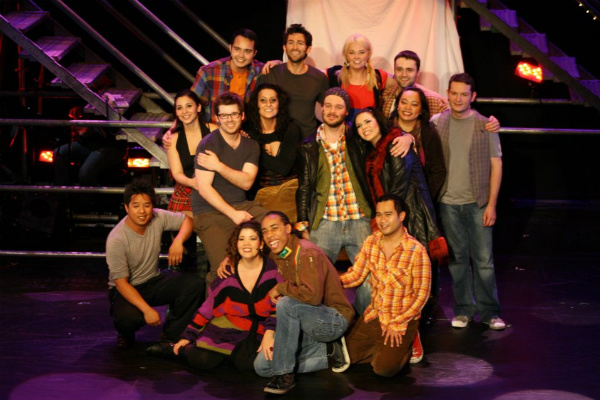
Have to admit, I can't look at this lot without my mind instantly turning to sex. I'd like to think I'm not alone in that though ... Brie?

If you aren’t aware of the story of HAIR, it is a beautiful one of belief, ideals, horrific decisions and growing up in the 60s. Couldn’t help but reflect on the youth of a very dear friend of mine from the 60s and how the horrors that he saw transformed the rest of his life.

So if you do nothing else between now and August 1st, be sure to go and see HAIR at the Waterfront Theatre.  Trust me, you and your date will be thanking me for it.

Here’s a little preview:

and they have more teasers here.

Kisses,

Emme xoxo

PS Now Ryan – if any cast get sick this week, Brie and I would be happy to fill in.

PPS To the Two Gentlemen at the Cat’s Meow after the Show: It doesn’t matter how titillated HAIR may make a gal, comparing her hair to that of a horses and then commenting on her fine set of chompers, as though she was a horse at an auction, is not at all likely to get you any action.

Swiss Miss

I’ve always had a fondness for the Swiss, thanks to Stefan and his serenades.  Well … that fondness only grew yesterday after attending the opening of Maison de la Suisse.

Maison de la Suisse

Maison de la Suisse at Bridges on Granville Island

Very quickly I came to the realization that Switzerland is a Nation that has a fondness for many of the same thing as me – good cheese, chocolate, sausage, wine and views. And best of all, they shared this with those of us that joined them for the Opening. One Swiss gentleman, even let me bite into his schnitzel. Nom, nom, nom nom …

A View from Switzerland

A View from Switzerland

Never fear if you missed it yesterday, they are open for the public from now until February 28th, daily from 8 am – 1 am.  Here’s what you can expect if you visit:

  • Different yummy samples each day of cheese, chocolates, coffee, biscuits, and ricola.
  • St. Moritz Musicians daily at 2, 5, 8 and 10 pm.
  • Commercial Free Live Broadcast of the Games.
  • A great view!

Dreaming of a Swiss Chalet

Click here for their full schedule for Vancouver and Whistler. And a few dates to mark on the calendar:

Cheering on the Swiss

  • Swiss Day Vancouver today 3 – 7 pm
  • Kids Story Time with Globi in Vancouver Wed Feb 10, 10 – 11:30 am & 2 – 3:30 pm
  • Kids Story Time with Globi in Whistler Thurs Feb 11, 10 – 11:30 am & 2 – 3:30 pm

Kisses,

Emme xoxo